Parashah Ponderings

Searching for Shalom at the End of 2020

In the new Pixar film Soul, which my family and I watched on Disney+ this week, we encounter two souls in search of peace and wholeness. A jazz musician finds little satisfaction as a high school music teacher, believing that he will only find contentment as a performer in a jazz quartet. Another character, an unborn soul, struggles mightily to find that one “spark” that will animate its life on Earth, and in Pixar’s realm of the unborn, the soul can only make it into the land of the living once it has discovered that “spark.” And so, the jazz musician and the unborn soul reluctantly pair up in their search for that one thing that will give them peace of mind, body and, yes, soul.

What the characters in Soul are searching for is what we’re all searching for: shalom.

Now, shalom means much more than “hello, good-bye and peace.” At the root of shalom are the letters shin lamed mem, which form the word shaleym, “to make something whole or complete.” The truth is there is never peace where there is no wholeness. Whether it be warring nations, a psyche pulled in different directions or a body fighting off disease or repairing tissue, until all the pieces in conflict start working in concert there is only chaos and discord. Thus, when we recite the Misheberach blessing for healing, we pray for refuah shelayma, a complete healing for all who are ill. In essence, we are asking God to restore to the “broken” body shelaymut, wholeness, to allow the body’s systems to work in sync — and in sync with medical therapeutics — to overcome the source of ailment, to restore peace to body, mind and soul.

The relationship of peace and wholeness extends as well to our coping with the year from Hell that we are ushering out this week. As we say “Good riddance!” to 2020, we all pray that 2021 will bring us shalom in the fullness of its meaning. As witnesses to senseless killing and violence in the streets, we pray that 2021 will bring us peace. As citizens of a country torn apart by tribal politics, we hope that 2021 will bring our nation closer together. As human beings struggling with the emotional, physical, social and psychological tolls of Covid-19, we cry out for shalom in the new year. For 2021, it will be sufficient to have a peaceful year in which we can reconnect not only with friends and loved ones but with those “other people” with whom we vehemently disagree. 2021 should also be a time when we can connect or reconnect with our better, higher selves. In short, we hope that in 2021 we can realize the peace and wholeness that have eluded us these past months.

As if on cue, the Torah this week also addresses the search for peace and wholeness. As we read the last chapters of the Book of Genesis, we find our ancestors — Jacob and Joseph and their whole family — achieving shalom once and for all. Prior to his death, Jacob asks that he be buried in the very cave where Abraham, Isaac, Sarah, Rebecca and Leah were laid to rest. Having lived a life of turmoil, Jacob finally lies in repose amid the wholeness of his family and at peace in God’s promised land. Joseph’s brothers, who want nothing more than to live in peace alongside Joseph following the death of Jacob, also find shalom. And Joseph, in a remarkable display of resilience, puts his brother’s mistreatment behind him and comes to accept God’s role in his tumultuous life. Ultimately, Joseph, like his father, asks that his bones be buried in the Land of Israel, and they will be — albeit over 400 years later — allowing Joseph posthumously to realize the fullness of shalom in the land of his birth.

The Book of Genesis, which chronicles the early life of the family of Israel, closes with the tying up of loose ends — with shalom. The book opens with tohu va-vohu — formlessness and void — that is replaced by God’s created, orderly universe, a universe at peace with itself. Then we read of the dramatic creation of humankind and its failed attempts at inhabiting the Earth. Though the rainbow appears to be a symbol of peace following the Flood, it is symbolic only of God’s covenant with humanity; humans apparently are left to duke it out amongst themselves. Then, we learn of the trials and travails of our first monotheistic ancestors from Abraham and Sarah through Jacob, Leah and Rachel and their family. Lots of ugliness there. And now, at last, we are treated to “happy ever after” (until next week, at least, when we start reading about slavery in Egypt in the Book of Exodus). After the rollercoaster ride that is Genesis, we deserve this week of shalom in Parashat Vayehi, a week of restfulness when all the factions work in harmony.

After the rollercoaster ride that was 2020, we deserve much more than a week of shalom, and Hollywood, Torah and real life seem to be speaking in one voice in this regard. I encourage you to see Soul and let me know what you think. I see it as a story about our search for shalom, i.e. peace and wholeness. Torah functions much the same way. Sometimes moments of peace are obvious, but even amidst warfare, doubt, and kvetching, God is behind the scenes trying to make everything work out well. And then there’s us in this moment. We’ve been through a lot, and we certainly have a few, perhaps many, months to go before the pandemic is behind us and our nation, God willing, emerges from dystopia. The prophets Peter, Paul and Mary once asked “for the wisdom to know when the peacemaker’s time is at hand.” We see that time in Soul and in Torah. Might that time for us be in the coming year?

May we find in 2021 that which we all seek — shalom, a time of peace and wholeness.
Parashah Ponderings

Learning in Egypt and the Survival of the Jewish People

Parashat Vayigash / פרשת ויגש
Torah Portion: Genesis 44:18 – 47:27

The history of Israel’s 400-plus year exile in Egypt, foretold in a divine revelation to Abraham earlier in the Book of Genesis (15:13), begins in this week’s Torah reading, Vayigash. The reading opens with Joseph revealing himself to his brothers, who had journeyed to Egypt in search of sustenance during the famine in Canaan (45:4). Prior to now, the band of brothers had been unaware that the Pharaoh’s vizier, to whom they were pleading and who put them through a series of nerve-wracking trials, was the brother whom they had long ago sold into slavery and about whom they told their father, Jacob, had been devoured by a ravenous beast.

All seems to end well in this parasha. Pharaoh invites the brothers to resettle their clan in Egypt. Jacob learns that Joseph is alive and well. Father and son are reunited. And all 70 members of Jacob’s household emigrates to Egypt, where they will wait out the famine and eventually thrive. Still, the Children of Israel are in exile in Israel. They literally “went down” to Egypt.

The exile motif has already appeared in the Torah several times. Recall that Adam and Eve were banished from the Garden of Eden in chapter 3 of Genesis. Later, Cain would be exiled (4:16). Then, each of the patriarchs would experience dislocation in one way or another either within Canaan or without. All these stories are part and parcel of Israel’s national story, serving to define Israel’s relationship with God and the land of Israel and giving shape to their mission in the world.

The exile of Jacob and his family, however, would last much longer than all the others and prove to be a great test of Israel’s ability to maintain its self-identity. By the time God liberates the Hebrews from Egyptian bondage, they will have preserved a modicum of identity with their past as told through the stories of Genesis, but they will have effectively switched allegiance from the God of Abraham, Isaac and Jacob to the gods of the Egyptians (see the article entitled “The Religion of the Israelites in Egypt” by Michael Alan Stein at http://jbq.jewishbible.org/assets/Uploads/393/jbq_393_religioninegypt.pdf). While the extended sojourn in Egypt would engrave the experience of servitude upon Israel’s consciousness, the Hebrews’ link to their ancestral religion would become tenuous, at best.

Rather than discount Israel’s flimsy identification with the God of their ancestors and focus on their assimilation into Egyptian culture – an assimilation which might have been complete had not the experience of bondage brought them together as an oppressed people – we ought to celebrate that our enslaved forebears retained any identity as the People of Israel at all. In fact, on the eve of Israel’s liberation, the Hebrews’ response to Moses’s command to ready themselves for the exodus suggests they had recovered, at least in part, from the amnesia induced by centuries of disconnection from the Promised Land and the halt in progress of their nation’s narrative.

In looking for clues to the survival of Israel’s identity during their exile in Egypt, we find light in the commentary of Rashi, the preeminent medieval French commentator. As Jacob prepared to relocate his family, he sent his son Judah ahead to “show (le’harot) the way before him to Goshen” (46:28). Rashi shares a rabbinic midrash on the word “le’harot,” which can be translated as “to teach or instruct,” that says that Jacob had sent Judah ahead in order to establish in advance a house of study, from which teaching would go forth. The idea that Jacob would have a house of study established before his arrival to Goshen reflects the sages’ wisdom that for diaspora Jewry Jewish learning is essential to continuity and survival. It certainly is the case that traditions survive because one generation teaches them to the next. When there is no transmission of a people’s narrative or creative myths, there can be no lasting memory and the people’s identity is doomed to fade away. The rabbis of old understood that for Judaism to flourish, Jews need to teach their children and grandchildren what it means to be Jewish.

The midrash that Rashi shares is surely a projection of the rabbinic mind onto the Torah, but while it is unlikely that there were houses of Israelite study in Egypt prior to the exodus, it is not at all unlikely that Jacob’s sons told the story of their people to their children and their children’s children. Thus began an oral tradition that helped preserve the Hebrews’ identity as B’nai Yisrael, the Children of Israel.

In an age when the demographics of Jews in America continue to show waning commitments to Jewish religion and institutional affiliation, we ought to heed the lesson embedded in this week’s Torah portion. Without houses of study or, at least, houses in which parents and grandparents actively relate Jewish wisdom to their heirs, Jewish identity is doomed to dissolve. Such dissolution of identity may have been total for our ancestors in Egypt were it not for those elders who saw to it that the stories of the Children of Israel would be taught from generation to generation.

It is my hope that the American Jewish community will always find “Judahs” in each generation to safeguard Jewish learning and set up teachers for our children who will transmit to them the stories of our past and visions for our future. In this way, the People of Israel will live.

Parashah Ponderings

Lessons from a Classic Debate about How to Light the Hanukkah Candles

The question of how to light the Hanukkah candles was hotly contested by two great rabbis in the Talmud, Hillel and Shammai. The Talmud is the central body of Jewish law and lore that developed between the 2nd and 5th centuries CE in both Palestine and Babylonia. Though the debate over the Hanukkah candles occurred two millennia ago, it is worth reminding ourselves what the issues were then and seeing what lessons each side has to offer us today.

As heads of the Sanhedrin at the beginning of the first century of the common era, Hillel and Shammai distinguished themselves for their knowledge of Jewish law and their ability to adapt to changing social, political and religious circumstances. Most of all, though, Hillel and Shammai are remembered for their divergences of opinion. Typically, Hillel would take a lenient, humanitarian approach to matters, and Shammai veered toward strict legalism. While the opinions of Hillel and his students were accepted more often than not by the rabbis of the Talmud, Shammai’s positions did emerge as normative on occasion. In any case, both rabbis’ positions and those of their disciples became a matter of record, an indication of the esteem accorded them by later generations.

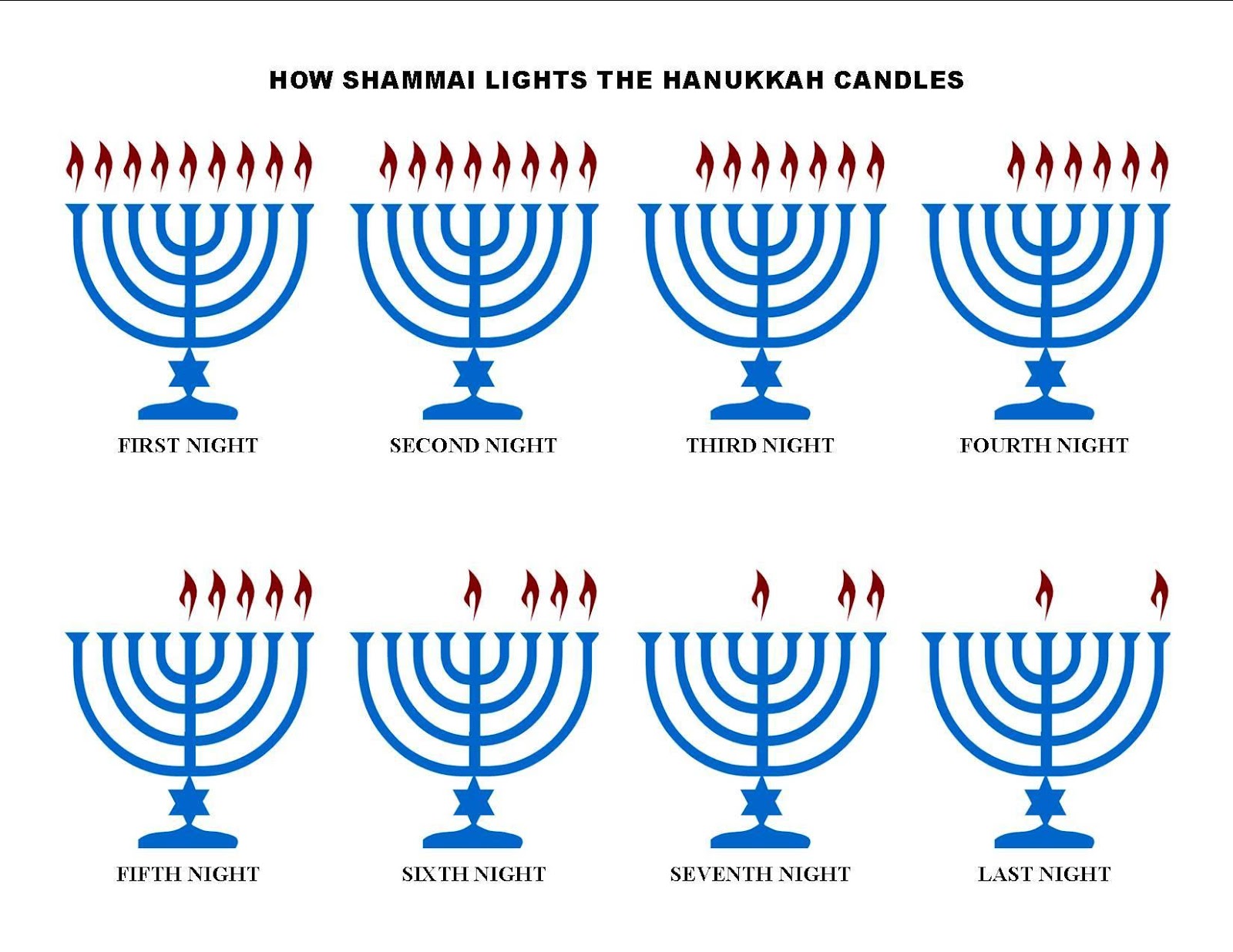
One disagreement between the schools of Hillel and Shammai is of especial note at this time of year: should we light all eight candles of the Hanukkah menorah (properly called a hanukkiah) on the first night and take away one candle on subsequent nights or should we light one candle the first night and add one candle on subsequent nights? Beit Shammai (the House or School of Shammai) held the first view, Beit Hillel the second. Beit Hillel emerged victorious, and it is their order of lighting that we use today.

Why would Beit Shammai argue that we should begin Hanukkah by lighting all the candles first and decrease the light as the holiday progresses? One reason was to have the number of candles correspond to the number of days remaining, from eight on the first night to one on the last. Another reason was so that the procedure for kindling the Hanukkah lights would mimic how the priests sacrificed a total of 70 bulls during the festival of Sukkot. While the Temple stood in Jerusalem, the priests would sacrifice a diminishing number of bulls from 13 on the first day to 7 on the last.

Though both of these reasons were compelling in their day, the latter might have had special appeal to the rabbis since it speaks to the very origins of Hanukkah. In 165 BCE, the year the Maccabees recaptured the Temple from the Syrian Greeks, the fighters had been unable to observe Sukkot at its proper time in the month of Tishrei (October in the Roman calendar). Thus, when the fighting ceased two months later, in the month of Kislev, the Maccabees rededicated the defiled Temple by rekindling the eternal light and offering the Sukkot sacrifices at that time. This late observance of Sukkot eventually morphed into what we now know as Hanukkah — which means “dedication” in English — with the lights substituting for the sacrifices. If we were to diminish the number of candles each night of Hanukkah, we would be re-enacting, in a way, the ritual as practiced by the Maccabees themselves.

As sensible as Beit Shammai’s method of kindling the hanukkiah was, Hillel’s method was favored by the rabbis for at least two reasons. By increasing the lights by one each day, the number of lights corresponded to the appropriate day and might have served as a mnemonic device to help people remember which day of the holiday they were celebrating. A more powerful reason for following Beit Hillel’s procedure, however, was that it reflected the rabbis’ desire to increase joy with each passing day, a desire that extended beyond Hanukkah to life itself. Perhaps because life was so difficult for Jews, the rabbis wanted to preserve the practice which would most likely lift people’s spirits in the darkest days of winter.

Today, Hillel and Shammai and their students present us with a choice. Shammai and his school would have us look toward our glorious past, to remember the Temple and its sacrifices. Hillel and his school would have us look to the future, to embrace a life full of possibility. As the classic example of an “argument for the sake of Heaven,” this debate offers an abiding Truth: as Jews we must be firmly rooted in the soil of our heritage in order to grow new branches extending upward and outward toward the future. Still, while the past and all its lessons may shine a light on the present, only the future can continue to grow brighter.

Therefore, as we kindle the lights of Hanukkah and recall the miracles that befell us in days of yore, let us now rededicate ourselves to building a more radiant future — a future filled with appreciation for all who are different from ourselves, a future free of preventable diseases, a future of wellness for our planet, a future of blessing.

Wishing you joy and light this Hanukkah,
Rabbi Dan

Parashah Ponderings

Jacob’s Rite of Passage: Celebrating the New, Appreciating the Old

Parashat Vayishlach / פרשת וישלח
Torah Portion: Genesis 32:4 – 36:43

When last we saw Esau, he had just left home after having spent much of his life a victim of his younger brother’s antics. In utero, Jacob had tried to pull his twin brother back into the womb so that he could be born first and, thus, merit the birthright and blessing of the oldest son. Later on, he took advantage of a tired, hungry Esau and convinced him to sell the birthright for a bowl of lentils. Finally, Jacob stole from Esau the most precious thing of all — their father’s blessing. Imagine Esau’s anger upon discovering he was once again a victim of Jacob’s scheming! Imagine, too, Jacob’s fear of encountering Esau years later. This week, we witness the brothers’ reunion, a reunion that against all odds is peaceful and marked by contrition and forgiveness.

Before Jacob embarks on his journey to meet Esau, something incredible happens. Jacob wrestles all night long with a mysterious being on the banks of the Jabbok River. Depending on whose commentary or scholarship you read, the being is either an angel of God, Esau’s guardian angel or a river spirit, the latter reflecting a belief common in the ancient Near East. Regardless of whom or what Jacob wrestled, Jacob emerges from the experience but with a limp, a blessing and a new name — Israel. It is as if he becomes a new man overnight.

This scene follows 20 years during which Jacob labored for his father-in-law, Laban, and got a good dose of his own bitter medicine. Just as Jacob had tricked his brother, Laban does the same to Jacob, switching out one bride for another, changing the terms of his servitude and cheating him of earnings rightfully accrued over his years of servitude. When Jacob manages to extricate himself from his servitude to Laban and leaves with two wives, eleven sons, a daughter, and a sizable flock of sheep and goats that he somehow genetically engineered to be strong and healthy, he is a smaller, more humble person than he had been as a youth. Thus, the scene at the Jabbok marks Jacob’s maturation, emboldens him for his fateful reunion with Esau and establishes him as the worthy father of a great nation. Life begins anew the day after that struggle not only for Jacob (now, Israel) but for us, the Children of Israel, as well. For us, we can now rest assured that our patriarch is more than the slimy trickster we had seen earlier in the Torah.

For Jacob, what happened at the Jabbok is a rite of passage celebrated by taking on the name Israel. Jacob is not the only patriarch to undergo such a rite. Recall that Abraham had been Abram prior to entering into a covenant with God. Notably, the circumstances in each case are quite different. God had known Abraham to be righteous and just before singling him out for the covenant. Thus, the name Abraham — containing the Hebrew letter “hei,” part of the name of the God, whom Abraham has vowed to serve — indicates a change in status. Sarai, Abraham’s wife, is equally meritorious of a name change; God adds the letter “hei” to her name, too, and she becomes Sarah. In Jacob’s case, though, the name Israel indicates more a change of heart than a change in status. The name Jacob derives from words connoting stealth and cunning. Israel, on the other hand, means “one who wrestles/struggles/strives with God.” Jacob began life as an unlikely role model for his descendants, but ends life as one who accounts for his actions and answers to God.

We do not today refer to Abraham or Sarah as Abram or Sarai unless we are referring to those verses in the Torah where their names are still Abram and Sarai. Yet, with Jacob, sometimes we call him Jacob and sometimes we call him Israel. Why not only “Israel?” In the case of Abraham, there was nothing especially compelling to remember about his earlier life. Not so with Jacob, for he changed dramatically over time and for the better. We can’t celebrate who Jacob becomes unless we remember who he once was. Moreover, Jacob’s earlier traits of ingenuity and craftiness may serve humanity well when used for higher purposes. It is quite possible that without those traits, Jacob wouldn’t have been able to become Israel. For the Children of Israel, we, too, have needed to employ ingenuity and craftiness throughout our history just to survive. Were there no “Jacob” inside of us, there could be no “Israel.”

Certainly, the coronavirus has demanded that we think creatively about how to stay connected as a community and serve the physical, educational and spiritual needs of our members. Thank God, therefore, we still carry some of the younger Jacob within us, albeit a more refined and sensitive Jacob.

As we look back on that night by the Jabbok River, we can identify with our ancestor who wrestles with God, angels and spirits and emerges stronger and nobler. As the Children of Israel, let use the skills and wisdom we have gained through our own experience to get us through this moment in history and continue to build a vital, stable, peaceful future for us and our world.

Shabbat Shalom,
Rabbi Dan